Flowtriq: AI-Driven Real-Time DDoS Detection and Mitigation
DDoS Detection in Real-Time: The Anatomy of Flowtriq
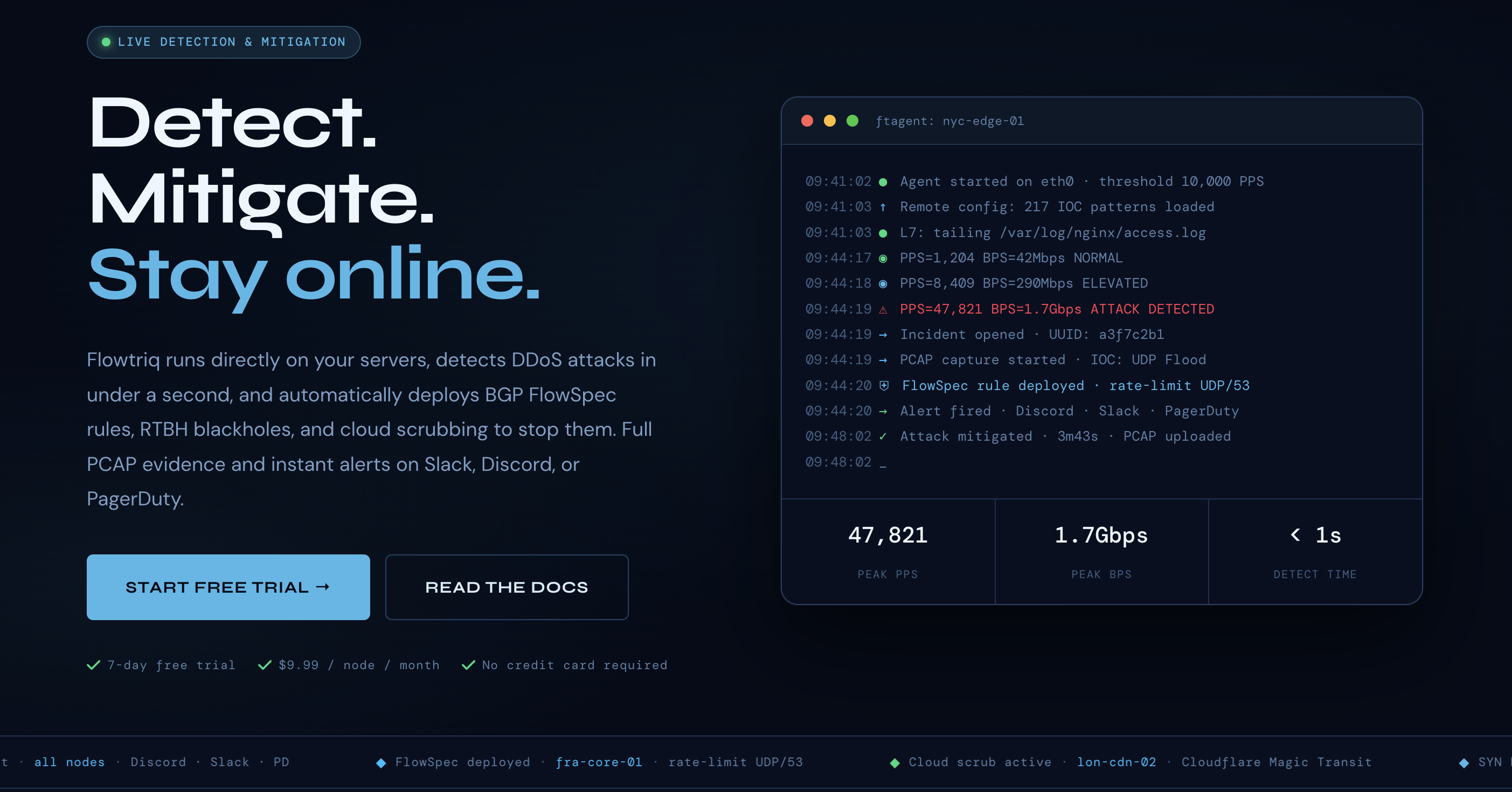
You know the feeling of dread when your server crashes under a sudden, unrelenting barrage of traffic. Your team scrambles to respond, but the damage is done – users are already fleeing, and your reputation is on the line. This is the harsh reality of Distributed Denial-of-Service (DDoS) attacks, which can bring even the most robust infrastructure to its knees. Enter Flowtriq, a lightweight, agent-based DDoS detection and auto-mitigation platform designed to detect and mitigate attacks in under 1 second. But how does it achieve this impressive feat?
Flowtriq's core technology stack is built around a Python agent (ftagent) that installs directly on Linux servers, reading packets directly from the NIC and connecting to the Flowtriq cloud dashboard. This design philosophy prioritizes speed and simplicity, allowing for seamless integration with existing infrastructure. By leveraging machine learning algorithms to learn the server's normal traffic baseline, Flowtriq can detect anomalies in real-time, automatically triggering mitigation measures without manual intervention.
Architecture & Design Principles
Flowtriq's architecture is designed for scalability and reliability, with a focus on real-time processing and automation. The ftagent is built to handle high volumes of traffic data, utilizing a combination of packet capture and machine learning to identify potential threats. The cloud dashboard provides a centralized management interface, allowing users to configure escalation policies, monitor attack activity, and access forensic analysis tools. Key technical decisions include the use of BGP FlowSpec rules, RTBH blackholes, and cloud scrubbing to mitigate attacks, as well as the implementation of a dynamic baseline learning mechanism to adapt to changing traffic patterns.
Feature Breakdown
Core Capabilities
- Sub-second detection and classification: Flowtriq's machine learning algorithms can detect and classify 8+ attack types, including SYN flood, UDP flood, and DNS amplification, in under 1 second. This enables rapid response and minimizes downtime.
- IOC pattern matching: Flowtriq's threat intelligence database contains over 642,000 known threat indicators, including Mirai botnet variants, allowing for precise identification and mitigation of known threats.
- Automated incident response: Flowtriq's runbooks enable users to chain mitigation steps into playbooks, streamlining response efforts and reducing manual intervention.
Integration Ecosystem
Flowtriq provides a range of integration options, including APIs, webhooks, and third-party connections to popular tools like Discord, Slack, and PagerDuty. This allows users to seamlessly integrate Flowtriq with their existing workflows and notification systems.
Security & Compliance
Flowtriq prioritizes data handling and security, with features like immutable audit logs, status pages for communicating downtime to users, and threat intel & IOC correlation. The platform also offers enterprise readiness, with custom IOC libraries and 365-day PCAP retention available on the enterprise plan.
Performance Considerations
Flowtriq's performance is optimized for speed and reliability, with a focus on real-time processing and automation. The platform's resource usage is minimal, making it suitable for deployment on a wide range of infrastructure.
How It Compares Technically
Flowtriq's technical approach differs significantly from alternatives like Cloudflare's DDoS protection, which relies on a more comprehensive suite of security features, including WAF and SSL/TLS encryption. In contrast, Flowtriq's focus on real-time detection and automation makes it an attractive option for organizations seeking a lightweight, specialized DDoS solution.
Developer Experience
Flowtriq's documentation is comprehensive and well-organized, with clear instructions for installation, configuration, and troubleshooting. The platform's SDKs and APIs are well-documented, making it easy for developers to integrate Flowtriq with custom applications and workflows. Community support is also available, with a range of resources and forums for users to share knowledge and best practices.
Technical Verdict
Flowtriq's strengths lie in its real-time detection and automation capabilities, making it an attractive option for organizations seeking a lightweight, specialized DDoS solution. While it may not offer the comprehensive suite of security features found in more robust solutions, Flowtriq's focus on speed and simplicity makes it an ideal choice for organizations prioritizing rapid response and minimal downtime. Limitations include the potential for false positives and the need for ongoing threat intelligence updates to maintain effectiveness.
External Resource
Access Flowtriq →