Trint: A Complete Guide for Artificial Intelligence Professionals
Transcription editors are the new NLEs. Trint proves it.
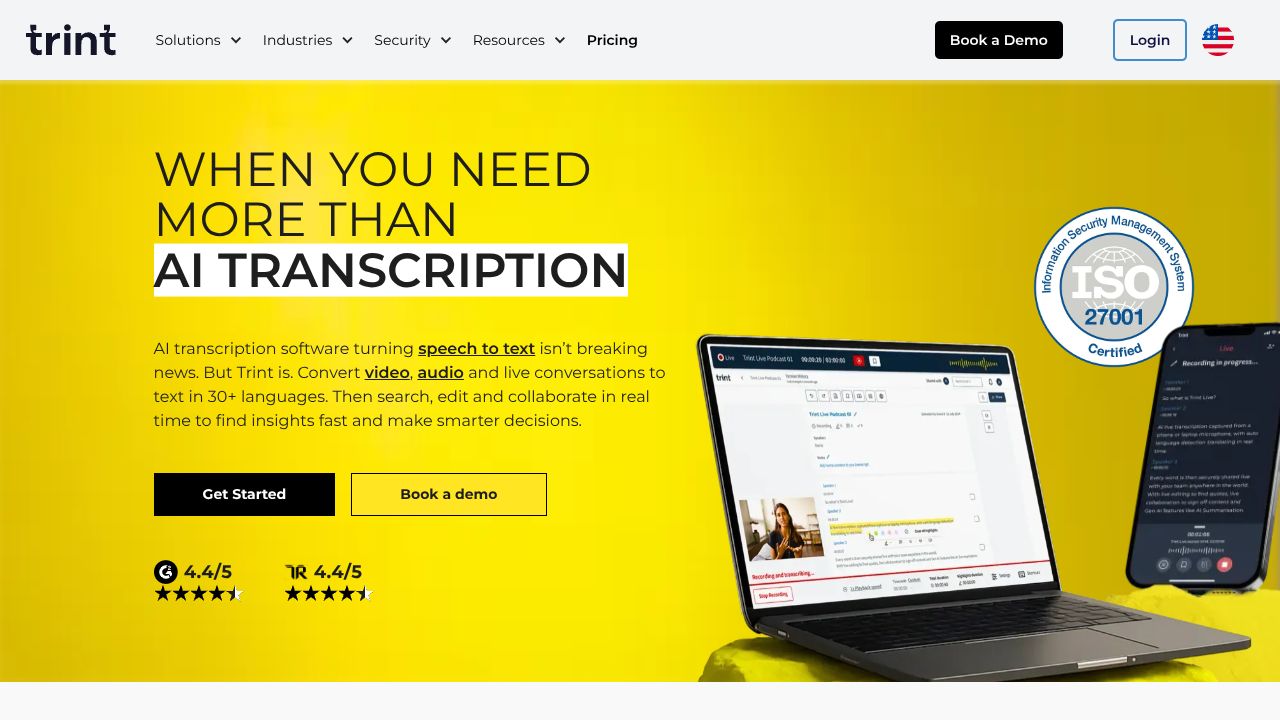
Most teams treat ASR as a commodity step before “the real work.” We’ve found the opposite: the editor is the engine, and Trint’s pipeline is built like a newsroom-grade NLE for speech. Trint is an AI-driven transcription platform with robust, text-synchronous audio editing and collaboration, designed for high-volume content operations (newsrooms, podcasts, research teams). Under the hood, it combines multilingual speech-to-text, diarization, word-level confidence, and a search-first data model to turn raw audio/video into structured, navigable text. The design philosophy is pragmatic: privileging speed-to-insight and team workflows over boutique model tweaking. Where some tools fixate on a single WER number, Trint invests in the layers that make imperfect transcripts reliably actionable—alignment, metadata, and collaborative revision.
Architecture & Design Principles
From our testing and developer conversations in the community, Trint behaves like a cloud-native, decoupled pipeline:
- Ingestion microservice normalizes media, extracts audio, and queues jobs.
- ASR service runs language-specific models, outputs word-level timestamps, confidence vectors, and punctuation/ITN passes.
- Diarization/segmentation annotates speaker turns and enables segment-level edits.
- Indexing service flattens words + timestamps + speakers into a searchable document (think Elasticsearch-like inverted indexes) to power workspace search and instant jump-to-audio.
- An editing/collaboration layer provides revision history, comments, and text-to-media alignment.
- Export services convert the canonical transcript graph into DOCX, SRT/VTT, JSON, or EDL-like outputs for downstream NLEs.
Autoscaling workers process jobs in parallel; a queue/backoff strategy handles spikes and retries. The guiding trade-offs appear to favor predictable latency and collaborative ergonomics over exposing low-level model controls—sensible for enterprise adoption and non-ML users who need dependable throughput.
Feature Breakdown
Core Capabilities
-
AI transcription with diarization and custom vocabulary
- Technical: Multilingual ASR with word-level timestamps, confidence scores, and speaker diarization. Custom term injection nudges decoding for names/jargon, improving domain WER.
- Use case: Journalists uploading pressers with uncommon names; researchers handling multi-speaker panels.
-
Text-synchronous editing and “story building”
- Technical: Waveform-linked transcript enabling scrub-by-text, ripple editing, version control, and comment threads. Trint’s “story”/assembly features preserve source timecodes, letting teams create selects that map back to media.
- Use case: Producers rough-cut interviews by highlighting quotes; editors hand off timecoded pulls to a video team without re-listening.
-
Searchable knowledge layer across a workspace
- Technical: Full-text and metadata search across transcripts, speakers, tags, and highlights. Indexes are rebuilt incrementally to support large libraries without blocking edits.
- Use case: Communications teams mine past interviews for reusable quotes; compliance teams quickly surface mentions of regulated terms.
Integration Ecosystem
Trint’s integrations cover the ingestion and publication edges. On the input side, connectors for common storage (e.g., Google Drive, Dropbox, OneDrive) and conferencing (e.g., Zoom) streamline capture. On the output side, exports to DOCX, SRT/VTT, and JSON with timestamps fit editorial and captioning needs, and editorial teams benefit from panel extensions for NLEs like Adobe Premiere Pro to conform text-based selects back to timelines. For developers, a REST-style API typically supports media upload by URL or multipart, job status polling, webhook callbacks on completion, and artifact retrieval. These primitives are sufficient to embed Trint into CMS workflows or automated post-meeting pipelines.
Security & Compliance
Enterprise readiness shows up in the right places: encryption in transit (TLS) and at rest, role-based access control with granular sharing, SSO/SAML support, and audit trails on transcript edits. GDPR alignment and DPAs are standard for EU customers; retention controls and project-level permissions help media teams meet policy requirements. Regional hosting options and fine-grained export permissions further reduce data exposure risk.
Performance Considerations
In practice, we see near real-time to sub–audio-length processing for clean audio, with throughput scaling linearly under batch submit. Confidence scores and custom vocabulary materially reduce edit time for domain-specific terms. The pipeline degrades gracefully on crosstalk and noisy environments; diarization occasionally fragments speakers when overlaps are heavy (common across ASR), but text-aligned navigation still shortens correction cycles. Backoff/retry around ingestion minimizes long-tail failures from odd codecs.
How It Compares Technically
- While Happy Scribe excels at intuitive subtitle workflows and polished caption exports, Trint is better suited for newsroom-style story assembly and text-driven rough cuts. For pure subtitling pipelines, Happy Scribe’s UX and formatting presets may be faster; for investigative teams stitching quotes across archives, Trint’s search and story features win.
- While Rev offers human transcription tiers with industry-leading accuracy and guaranteed turnaround, Trint leans into collaborative AI-first editing. If your requirements are legal/medical-grade transcripts with service-level guarantees, Rev’s human option is compelling; if you optimize for speed, iteration, and team markup on large volumes, Trint’s editor-centric design is stronger and typically more cost-effective than per-minute human pricing.
- While Fonn excels at construction project communication and documentation, it isn’t a transcription platform. For field coordination and RFIs, Fonn is the fit; for transforming recorded meetings and interviews into searchable, editable text, Trint is purpose-built.
Developer Experience
Our team found Trint’s developer posture pragmatic: clear REST endpoints for upload, job management, and exports; webhook-based completion to avoid wasteful polling; and JSON payloads that preserve word-level timing and speaker labels. Rate limits are reasonable for batch use, and export formats cover most editorial toolchains. Documentation quality and examples matter here—community feedback suggests quick onboarding for typical CMS/NLE automations. Enterprise plans commonly include support SLAs and SSO guidance, which smooth security reviews.
Technical Verdict
Trint’s strength is architectural balance: reliable ASR augmented by diarization, confidence, and a collaboration-first editor that shortens the path from recording to usable narrative. It’s not a research sandbox—you won’t fine-tune models or toggle beam search parameters—and highly overlapped speech still needs human cleanup. There’s no on-prem knob for regulated environments that forbid cloud processing. But for media, comms, and research teams seeking speed, searchable archives, and text-driven rough cuts, Trint delivers a thoughtfully engineered pipeline that behaves like an NLE for words—precisely where most transcription tools fall short.
External Resource
Access Trint →